A Cyberpunk Dev Defended Starfield’s Animations and Sparked a Lasting Debate
A Cyberpunk 2077 developer defends Starfield from animation criticism, calling it a necessary trade-off for sandbox freedom.
In the sprawling universe of gaming discourse, few rivalries have captured the community’s imagination quite like the comparison between Bethesda’s Starfield and CD Projekt Red’s Cyberpunk 2077. Back in late 2023, a minor firestorm erupted when a player known as SynthPotato took to social media, proclaiming that revisiting Cyberpunk 2077 had made them realize how outdated Starfield’s character animations felt. The remark, seemingly casual, lit a powder keg. Gamers who had spent hundreds of hours scanning alien biomes suddenly found themselves defending their interstellar odyssey, while Night City veterans nodded in agreement, their minds still swimming in the cinematic splendor of Phantom Liberty. What happened next surprised everyone—rather than ignoring the jab, a senior designer from CD Projekt Red himself stepped forward, not to gloat, but to offer a robust defense of Starfield’s design philosophy. That designer was Patrick K. Mills, and his words continue to echo in 2026 as both titles have evolved into cultural touchstones.
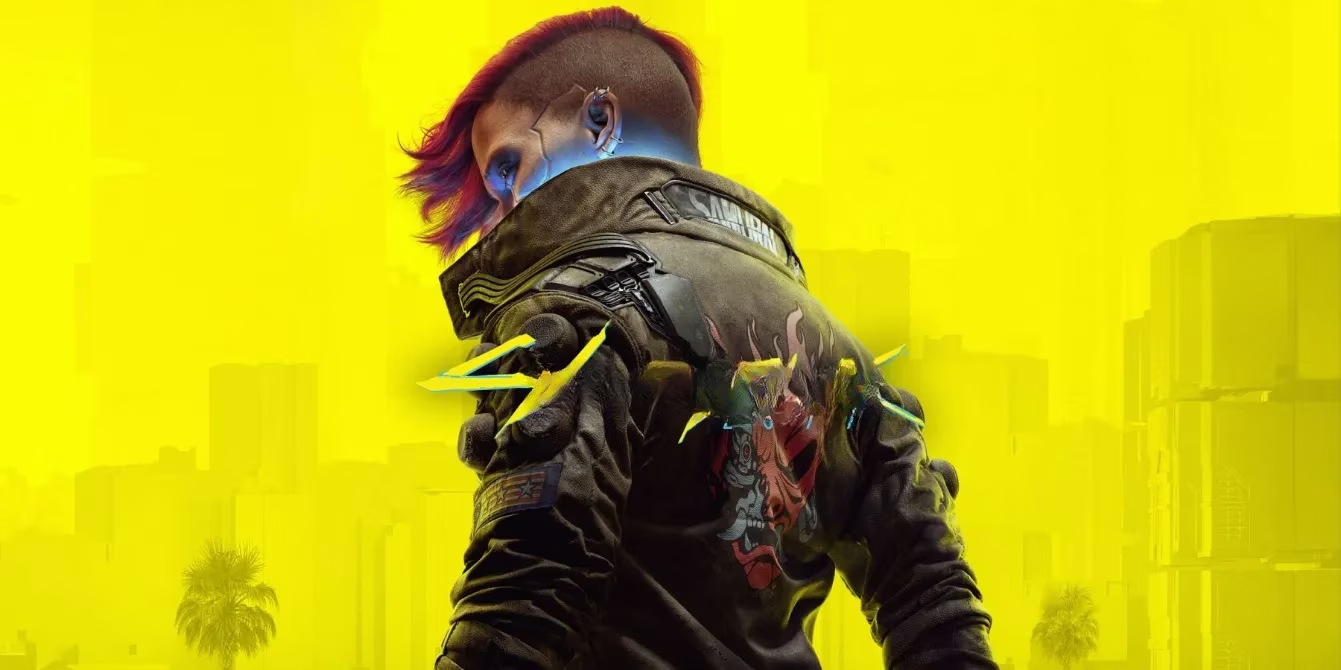
Mills, then a senior quest designer for Cyberpunk 2077, did not retreat into corporate rivalry. Instead, he publicly unpacked the fundamental differences between how Bethesda and CD Projekt Red build their worlds. He explained that while Cyberpunk 2077 employed meticulous, handcrafted cinematic sequences—often with first-person close-ups and painstakingly motion-captured performances—Starfield operated on a completely different axis. Bethesda’s engine was not the villain; the culprit was intentional design. Starfield aimed to give players a staggering level of freedom: land on any of a thousand planets, interact with a rotating cast of hundreds of NPCs, and trigger conversation scenes in a "mind-boggling number of possible locations." Creating bespoke, high-fidelity animations for each permutation would have frozen development forever. Was it worth sacrificing that limitless sandbox for a few extra glimmers in an NPC’s eye? Mills argued that every feature comes at a cost, urging players to see the bigger picture.
His defense cut deeper than a mere technical explanation. It raised a question that still haunts forums in 2026: can any single game truly excel at everything? If Starfield poured its resources into emergent storytelling and systemic freedom, did it have the right to be judged solely by the benchmark of Cyberpunk 2077’s cinematic intimacy? Mills invoked another giant of the era, Baldur’s Gate 3, recalling how some fans demanded that Larian’s opus magically become a real-time action game or that every RPG incorporate its branching narrative depth. The comparison was instructive—why did we treat Starfield’s animations as a failure, rather than a trade-off? The designer’s stance reframed the debate from a simple “which is better” to a more nuanced appreciation of divergent visions.
Of course, not everyone was convinced. Bethesda titles have long been criticized for wooden character interactions, debates that date back to Morrowind’s waxy faces. The launch of Starfield in September 2023 brought renewed scrutiny because it arrived in the shadow of Cyberpunk 2077’s triumphant redemption arc. CD Projekt Red’s game, once a cautionary tale, had transformed into a critical darling with Phantom Liberty, showcasing Idris Elba’s electrifying performance and world-class cinematic direction. How could a new space opera not look stiff by comparison when players were still wiping tears after the credits rolled on Night City’s espionage thriller? Starfield, meanwhile, was only beginning to stretch its legs, with a base game that offered countless hours of exploration but lacked the narrative urgency and polish of its competitor’s DLC.
Since those early skirmishes, both games have charted different destinies that lend Mills’s defense a prophetic quality. Cyberpunk 2077 concluded its redemption saga and then pivoted toward a sequel codenamed Orion, currently in development. Starfield, not to be outdone, delivered its first major expansion, Shattered Space, which doubled down on Bethesda’s strengths—intricate faction questlines, haunting alien mysteries, and player-driven exploration. The expansion’s release in late 2024 proved that Bethesda’s approach could still deliver unforgettable moments, even if its dialogue scenes never quite shed the beloved stiffness that fans have come to accept as part of the studio’s charm. The community stopped bickering about animation lip-sync and started sharing tales of terrifying encounters in the voids of space, exactly the type of organic player narrative that the game was designed to foster.
Mills’s commentary also sparked a broader introspection among developers and players alike. In a 2025 GDC talk, several designers cited the Starfield–Cyberpunk 2077 discourse as a watershed moment for managing player expectations. They repeated his core thesis: no studio can be the best at real-time combat, cinematic storytelling, environmental interaction, and infinite replayability all at once. Budgets, time, and engine constraints force choices, and those choices define a game’s soul. The next time you roll your eyes at a shopkeeper’s robotic greeting in Starfield, ask yourself—would you sacrifice the ability to seamlessly hop from a smuggler’s den on Neon to a derelict freighter adrift in the Serpentis system just for that NPC to wink more naturally? For millions, the answer remains a resounding no.
Looking back from 2026, when an entire generation of gamers now cherishes both titles for very different reasons, the firestorm of 2023 feels almost quaint. Starfield’s community thrives on ship-building contests and survival-mode exploits, while Cyberpunk 2077 disciples dissect every neon-drenched alleyway in search of Phantom Liberty secrets. That an animation debate could provoke such thoughtful insight from a developer on the “other side” reminds us that game creation is an art of compromise. Next time you load into your custom-built cockpit or step onto the rain-slicked streets of Watson, remember that the flaws you see are often the price of the freedoms you feel. And if you still think a star-baron’s facial capture looks stiff? Just be grateful that Mills and others were willing to explain why your freighter can actually fly to that distant moon instead of existing only in a lovingly rendered cutscene.