Elon Musk, Grimes, and the Cyberpunk 2077 Cameo That Almost Was
Elon Musk and Cyberpunk 2077 collide in a bizarre cameo request involving Grimes, Lizzy Wizzy, and a 200-year-old gun.
In 2023, Walter Isaacson's memoir on Elon Musk revealed a strange episode from the making of Cyberpunk 2077. By 2026, the tale still lingers like a neon stain on a rain-slicked Night City alley. According to the book, Musk arrived at a recording session for CD Projekt Red's role-playing epic, carrying a two-hundred-year-old gun. He was not invited. He was not expected. He was, by his own cheerful description, 'armed, but not dangerous.' The session he interrupted belonged to his then-partner, Grimes, who had been legitimately cast as the in-game musician Lizzy Wizzy.
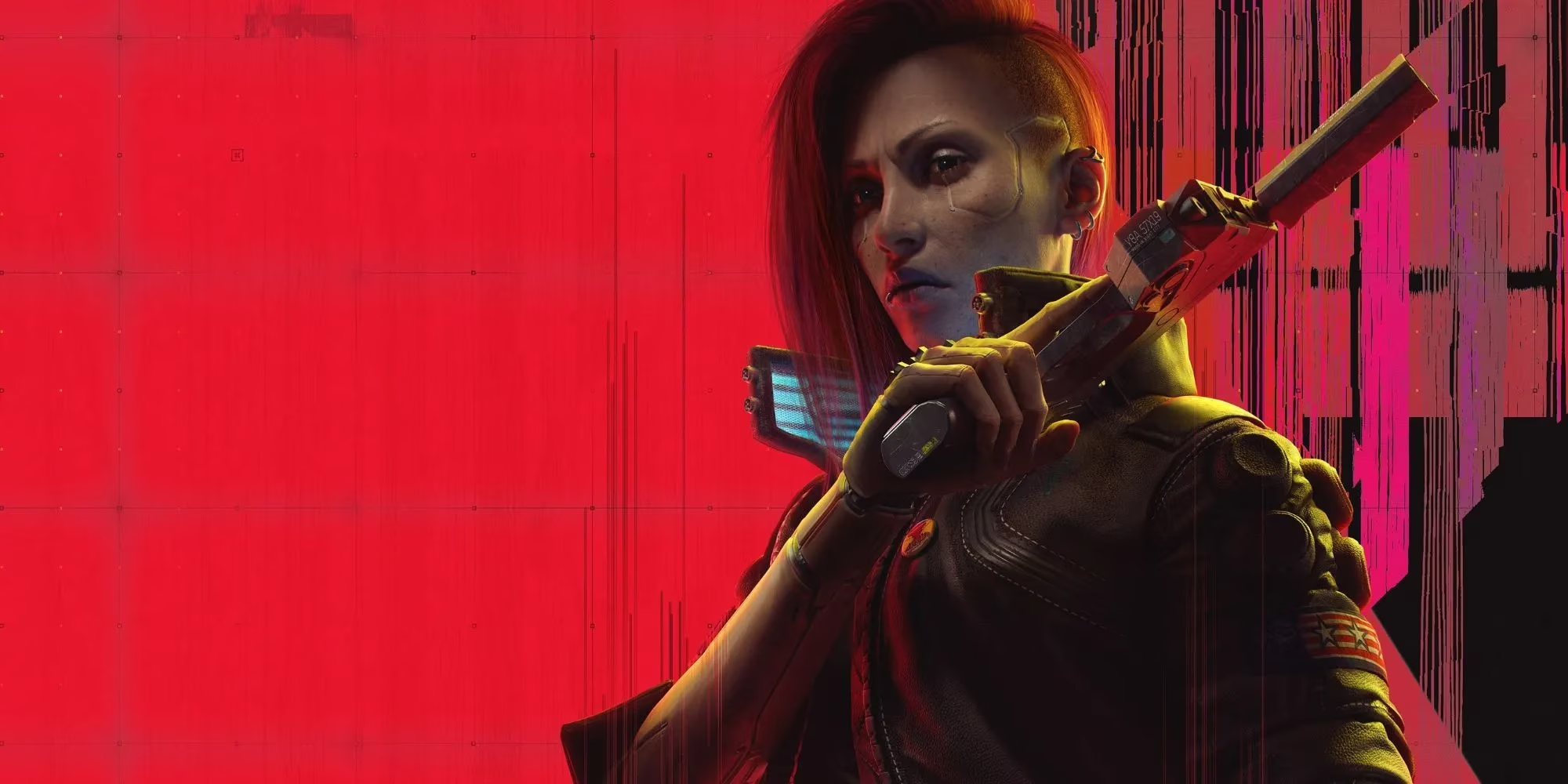
Grimes was recording her lines for the cyborg pop star, a character who appears in her own questline and whose tracks Delicate Weapon and 4ÆM can be heard on the in-game radio. Then Musk showed up. As Isaacson recounts, he insisted that the studio give him a cameo. The studio staff, according to Grimes, were sweating. The moment must have felt like a live grenade rolled into a meditation class: one wrong move, and the whole calm creative space would detonate into chaos.
He had a reason, or at least a rationalization. Musk later said he wanted in on Cyberpunk 2077 because its cybernetic implants hit close to home. That was a reference to Neuralink, his brain-chip venture. The comparison was less flattering than he might have hoped. By February 2022, Neuralink had been reported to have killed 15 monkeys during trials. In the world of Cyberpunk 2077, that kind of corporate behavior belongs to Arasaka or Militech. Musk may have seen himself as a visionary; the game's moral universe would have filed him under corpo.
Update: CD Projekt Red responded to TheGamer to confirm that it had no official comment on the story. However, a Cyberpunk 2077 developer later denied that a previously visible NPC was based on Musk's likeness. So he may not be in the game after all. The gun story, though, has not been denied. That detail has stuck like a shard of broken glass in a braindance.
| Element | What happened |
|---|---|
| The intruder | Elon Musk |
| The invitation | None |
| The prop | A 200-year-old gun |
| The quote | 'armed, but not dangerous' |
| The interrupted artist | Grimes, voicing Lizzy Wizzy |
| The request | A cameo in Cyberpunk 2077 |
| The denial | Developer denied an NPC was based on Musk |
| The un-denied part | The gun story |
By 2026, Cyberpunk 2077 has evolved. Phantom Liberty expanded the game, and CD Projekt Red has been working on a sequel, codenamed Project Orion. The original release's rocky launch is now part of a redemption arc. Yet this anecdote remains a peculiar side quest: a billionaire walking into a recording booth with an antique weapon and asking for immortality in a fictional dystopia. It is almost too on-the-nose. If a satirist had pitched it, an editor might have called it unrealistic.
Grimes's role, by contrast, was real and substantial. She did not merely cameo. She played Lizzy Wizzy, a cyborg pop star whose storyline fits the game's themes of identity, exploitation, and manufactured fame. Her music became part of the soundtrack. Musk's hoped-for cameo, if it ever existed, has been denied. The asymmetry is striking: she contributed art; he contributed an anecdote about a gun.
Maybe that is why the story endures. It is a small parable about access, ego, and the strange gravity of celebrity. Musk wanted to be inside a world that critiques the very kind of power he wields. He wanted to be a character in a story about characters being controlled by systems. The request landed like a stone dropped into a perfectly calibrated quantum engine: briefly loud, ultimately irrelevant to the machine's purpose.
In 2026, the gun is still the strangest detail. A two-hundred-year-old firearm in a voice-recording studio is not a creative tool. It is a prop from a different genre. It belongs in a Western, not a cyberpunk epic. The studio staff's discomfort makes sense. They were trying to build a futuristic dystopia; someone brought a relic from the past and asked to be written into the future. For all the talk, Musk's cameo may never have materialized. The story, however, did. And in the gaming industry's collective memory, it remains a weird, sweaty, neon-lit footnote.