Why Cyberpunk 2077's Sequel Must Fulfill the Ciri Connection
Cyberpunk 2077's sequel must finally fulfill the tantalizing promise of a Ciri crossover from The Witcher universe, transforming a lingering fan theory into a masterstroke of immersive world-building and deep fan service.
As a dedicated player who has spent countless hours exploring the neon-drenched streets of Night City and the monster-infested paths of the Continent, I can't help but feel a lingering sense of missed potential when I think about Cyberpunk 2077. The game has undergone a remarkable transformation since its tumultuous launch, evolving through numerous updates and the stellar Phantom Liberty expansion into the immersive experience we were promised. Yet, amidst all this redemption, there remains one glaring, unfulfilled promise—a whisper from another world that the sequel absolutely must address. I'm talking, of course, about the tantalizing connection to The Witcher universe through the enigmatic Ciri. It's a thread left dangling, a piece of lore that feels deliberately placed yet never fully grasped, and its resolution would be a masterstroke of fan service and world-building.
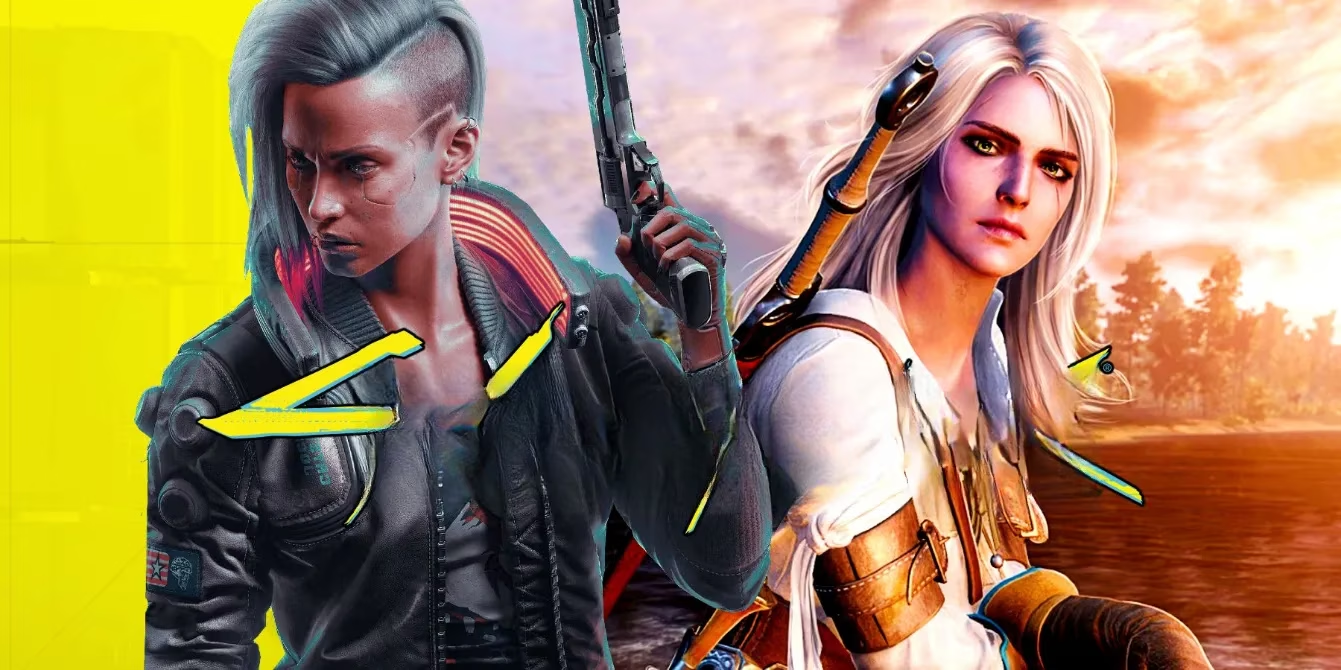
The foundation for this crossover was laid years ago in The Witcher 3: Wild Hunt. I remember vividly the moment Ciri described her otherworldly travels to Geralt. She spoke of a place where people had "metal in their heads," fought wars from afar with devices like megascopes, and traveled not on horseback but in personal flying ships. For any fan paying attention, the description was unmistakable. It wasn't just a generic sci-fi trope; it was a direct, almost cheeky, nod to the then-in-development Cyberpunk 2077. CD Projekt Red had the sci-fi IP front-of-mind, planning it years before The Witcher 3 even launched. This wasn't a coincidence; it was a planted seed. Yet, in the final release of Cyberpunk 2077, that seed never truly sprouted. Beyond a fleeting Easter egg photograph, Ciri's presence in Night City remained a phantom—a beloved fan theory confirmed only by implication, never by interaction. For someone who cherishes both franchises, this felt like an invitation to a party that never actually started.
Now, looking ahead to the sequel (codenamed Project Orion), the opportunity is clearer than ever. Incorporating Ciri in a meaningful way isn't just a nod to the past; it's a chance to enrich the future of both series. The beauty of this idea lies in its simplicity and low risk. Ciri wouldn't need to be thrust into the main narrative, which could risk convoluting the lore for newcomers. Instead, imagine discovering her in a self-contained side quest—a hidden gem in the sprawling metropolis. This approach offers immense creative freedom and comes with significant potential rewards:
-
Deep Fan Service: It would validate a long-standing theory, creating a powerful "aha!" moment for dedicated fans.
-
Lore Expansion: A conversation with Ciri could offer unique insights. How does a witcher, accustomed to magic and medieval strife, process the corporate dystopia and technological transcendence of Night City? Her perspective would be fascinating.
-
Emotional Payoff: We could learn about her emotional state after the events of The Witcher 3. Is she at peace? Still wandering? This would provide closure for her character arc in a new context.
-
Universe Bridging: It would formally establish a multiversal connection between CD Projekt Red's flagship worlds, opening endless possibilities for future narratives without forcing a full-blown crossover.
Practically speaking, implementing this would be straightforward. It wouldn't demand new game mechanics or systemic overhauls. A well-written quest with a unique character model, some poignant dialogue, and perhaps a small, meaningful choice for the player would be more than sufficient. The writers could craft a poignant, personal story that stands on its own while serving as a delightful treat for those in the know. In an age where game studios often play it safe, this would be a bold and confident move—a declaration that these worlds are connected by more than just a developer's logo.
As of 2026, the hype for the next Cyberpunk is building, and player wishlists are growing. Among requests for improved vehicular combat, deeper life paths, and more dynamic NPCs, the call to see Ciri walk the streets of a future Night City remains a passionate one. For me, it represents the final piece of a puzzle CD Projekt Red itself started. The redemption of Cyberpunk 2077 may be complete, but its story—and its connection to the legacy of The Witcher—is far from over. Fulfilling this promise wouldn't just be good fan service; it would be a testament to thoughtful, interconnected storytelling, proving that even in a world of chrome and code, there's still room for a little magic from another dimension. The sequel has the chance to not only advance its own narrative but to beautifully tie a bow on one of gaming's most intriguing unsolved mysteries.