Why The Witcher 4 Must Follow Cyberpunk's Edgerunners Playbook for Launch Dominance
Cyberpunk 2077's Phantom Liberty expansion and Edgerunners anime revolutionized gaming with emotional storytelling, offering a blueprint for The Witcher 4's success through synchronized, immersive narratives.
I still remember the electric buzz in the gaming community when Cyberpunk 2077 dropped its Phantom Liberty expansion. CD Projekt Red didn't just fix a game; they orchestrated a full-blown cultural renaissance. With Idris Elba stealing scenes and Night City gleaming with newfound polish, it felt like a redemption arc written in neon lights. But let's keep it 💯—what truly catapulted Cyberpunk’s comeback wasn't just gameplay tweaks. It was Edgerunners, the Netflix anime that aired a year prior. That show injected raw, gut-wrenching humanity into a world once criticized for being cold. David Martinez’s tragic tale wasn’t supplemental fluff; it was emotional jet fuel that made millions like me rush back to Night City. And that, my friends, is the golden blueprint The Witcher 4 needs to steal when it finally launches.
CDPR already proved they can nail synchronized storytelling with Cyberpunk. Edgerunners didn't just \u0022support\u0022 the game—it made us feel something deep before we even touched the controller. I booted up Phantom Liberty not for the guns or glitches, but because I needed closure for David’s story. That’s the power of a well-timed adaptation: it builds stakes no patch or DLC ever could. Fast-forward to 2025, and The Witcher franchise stands at a crossroads. We’ve got novels, games, Netflix dramas, and spin-offs like Thronebreaker, but they’ve always felt like scattered pieces rather than a unified force. Remember how detached Henry Cavill’s Netflix series felt from the games? Total missed opportunity. If The Witcher 4 drops solo, no matter how flawless, it’s just another RPG in a crowded field. But if it launches alongside a tight-knit adaptation? Game over. That’s how you dominate the discourse.
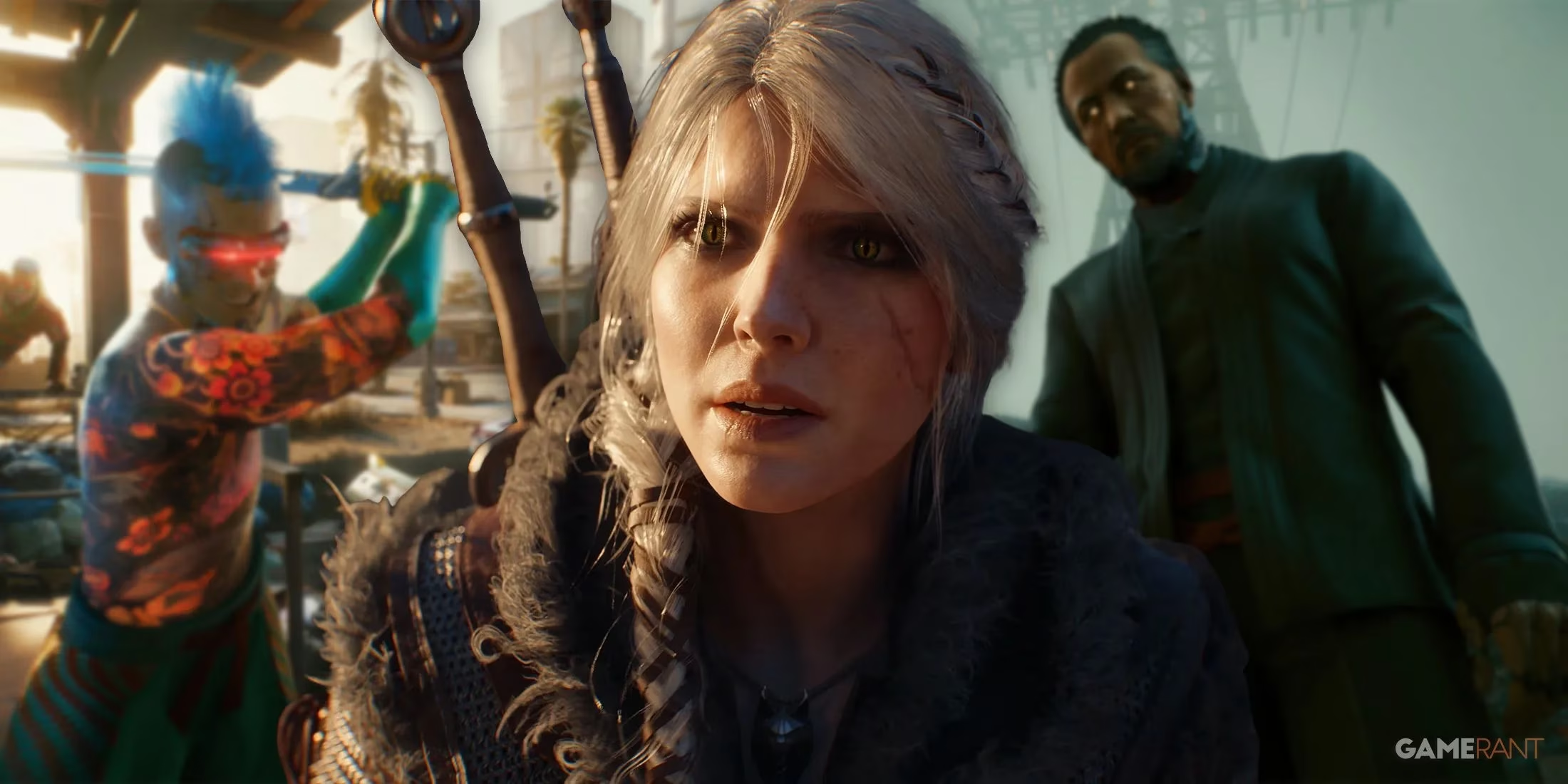
So, what should this Witcher tie-in look like? Keep it lean and mean. No lore dumps or Geralt rehashes—we need fresh blood. Picture a miniseries focused on the Lynx School witchers, those shadowy outliers barely mentioned in the books. Or an original character whose choices ripple into the main game, making players scream \u0022Holy moly!\u0022 when their actions cross over. Edgerunners worked because David was a nobody who became everybody’s hero overnight. The Witcher equivalent could explore themes like loss or mutant prejudice through a gritty, standalone story. And timing? Non-negotiable. Release it back-to-back with the game. Not months apart like the Netflix show, which felt like a distant cousin rather than a sibling. Launch them together, and suddenly, streamers react, non-gamers binge, and social media ignites. That ain’t just marketing—it’s storytelling at scale, baby!
People Also Ask: Why did Edgerunners resonate so hard? Simple: it humanized Cyberpunk’s world faster than any codex. I’d binge episodes, then log into Night City not for loot, but to leave flowers at Rebecca’s memorial. That emotional tether is everything. And how can CDPR avoid past mistakes? By making the adaptation essential, not promotional. No more \u0022optional\u0022 lore—we need heart-pounding stakes that force players to care before the title screen loads.
The benefits? Massive. Cyberpunk’s \u0022one-two punch\u0022 didn’t just spike sales; it rebuilt trust. When Witcher 4 lands with its own Edgerunners-level companion, it won’t just sell copies—it’ll own pop culture. Imagine normies watching the show, then diving into the game to avenge a fallen witcher. That’s how you turn a launch into a movement. CDPR has the formula now: pair razor-sharp storytelling with mechanical brilliance. Do it right, and even past hiccups like the Netflix disconnect will fade into harmony.
⚔️ Why This Strategy Slays:
-
Emotional Hook: Adaptations make worlds feel alive (e.g., Edgerunners’ tragedy → player action).
-
Community Fire: Sync releases to fuel memes, streams, and watercooler chats.
-
Accessibility: Newcomers enter via the show, then \u0022get gud\u0022 in the game.
| Cyberpunk 2077 Approach | Witcher 4 Opportunity |
|---|---|
| Anime released pre-expansion | Drop show/game simultaneously |
| New protagonist (David) | Original witcher or Lynx School focus |
| Standalone but emotionally tied | Choices that impact main game |
Ultimately, CDPR must go big or go home. Phantom Liberty fixed code, but Edgerunners resurrected a soul. For The Witcher 4, that means no half-measures. Give us a story so gripping, it’ll make us yell, \u0022Damn, I need to play NOW!\u0022 Anything less would be a witcher-size blunder. 😤
🔍 FAQ: Burning Questions Answered
- Q: Why was Edgerunners critical to Cyberpunk's revival?
A: It added emotional depth that gameplay alone couldn’t, making players invest in Night City’s humanity and driving massive engagement.
- Q: What type of adaptation suits The Witcher 4 best?
A: A miniseries or film focusing on unexplored factions (e.g., Lynx School) or new characters, with themes that echo into the game—keeping it essential, not optional.
- Q: How can CDPR avoid past missteps like The Witcher’s detached Netflix show?
A: By releasing the adaptation and game concurrently, ensuring narrative cohesion so they feel like intertwined siblings, not distant relatives.
- Q: What’s the biggest benefit of a coordinated media blitz?
A: Dominating cultural conversations across demographics—gamers, streamers, and casual viewers all get pulled into the ecosystem, boosting sales and sentiment.
- Q: Could this work for established franchises beyond The Witcher?
A: Absolutely! Synced storytelling is the future—imagine a Mass Effect series dropping with the next game. It’s about creating universes, not just products.